
🟠 Building Reliable Embedded Systems with Continuous Observability
"The feedback pipeline is how you close the loop between the software you deliver and the value it creates. This is where observability comes in. Observability is the practice of monitoring and reporting from your systems to gain actionable insights. It's about knowing what's happening inside your software-even in complex, distributed environments."
- Jacob Beningo, 2024
Observability in software systems refers to the ability to understand internal system behavior through information such as logs, system traces and memory dumps. Traditional debugging and analysis are often initiated after a problem has already been detected. Continuous Observability extends this approach by collecting and preserving relevant diagnostic information throughout development, testing and operation - making valuable runtime insight available when problems actually occur.
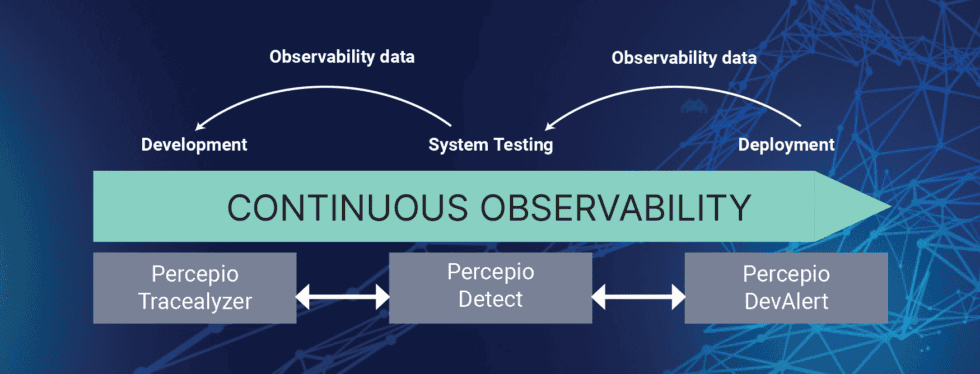
Percepio has a complete Continuous Observability offering, comprising Tracealyzer, Detect, and DevAlert. Together, these tools provide a unified approach that extends software observability across development, integration, testing and operation. From real-time insights during development to proactive detection in testing and actionable alerts in deployment, this framework empowers teams to deliver more reliable, efficient, and resilient embedded systems.
Percepio Tracealyzer - UNDERSTAND
Visualize and analyze runtime behavior in depth. Tracealyzer helps developers understand task execution, timing, system events and complex software interactions - providing the insight needed to investigate performance problems and root causes.
Percepio Detect - RECOGNIZE & CAPTURE
Monitor embedded software over extended periods. Detect recognizes stability risks and captures diagnostic evidence when relevant problems occur — particularly during integration, automated testing and field testing.
Percepio DevAlert - FEEDBACK
Bring diagnostic information from remote testing and deployed devices back to development. DevAlert helps engineering teams investigate problems using information captured from the environment where they actually occurred.
Together, Tracealyzer, Detect and DevAlert create an overarching Continuous Observability feedback loop:
Observe → Detect → Understand → Improve → Repeat.
Read more in Percepio's White Paper on Continuous Observability
The Value of Continuous Observability
Development — Understand Runtime Behavior
During development, Tracealyzer provides detailed visual insight into the dynamic behavior of embedded software. Developers can analyze task execution, timing, interrupts and software interactions, helping them understand complex runtime behavior and investigate problems at an early stage.
Testing — Recognize Problems under Realistic Conditions
During integration, automated testing and extended system testing, Detect can monitor software behavior over long periods. Stability risks and sporadic problems can be recognized when they occur, while relevant diagnostic information is captured for subsequent investigation.
Deployment — Feed Real-World Insight back into Development
During field testing and operation, DevAlert extends observability beyond the development laboratory. Diagnostic information from remote and deployed devices can be brought back to engineering teams, helping them investigate problems that may be difficult to reproduce under laboratory conditions.
Continuous Improvement — Close the Loop
The information gained during development, testing and operation becomes feedback for the next development cycle. This allows Continuous Observability to connect different activities across the Embedded Development Lifecycle and turn runtime insight into continuous software improvement.
Services & Support
Evaluation Software
Update: September 25th, 2026
© 2026 Carnica Technology. All Rights Reserved. Contact Us · Legal & Privacy