We help embedded engineering teams

to build better embedded software

with the right tools, expert guidance ...

and trusted support

🔵 SEGGER Embedded Middleware

Covering all Aspects of your Embedded Application
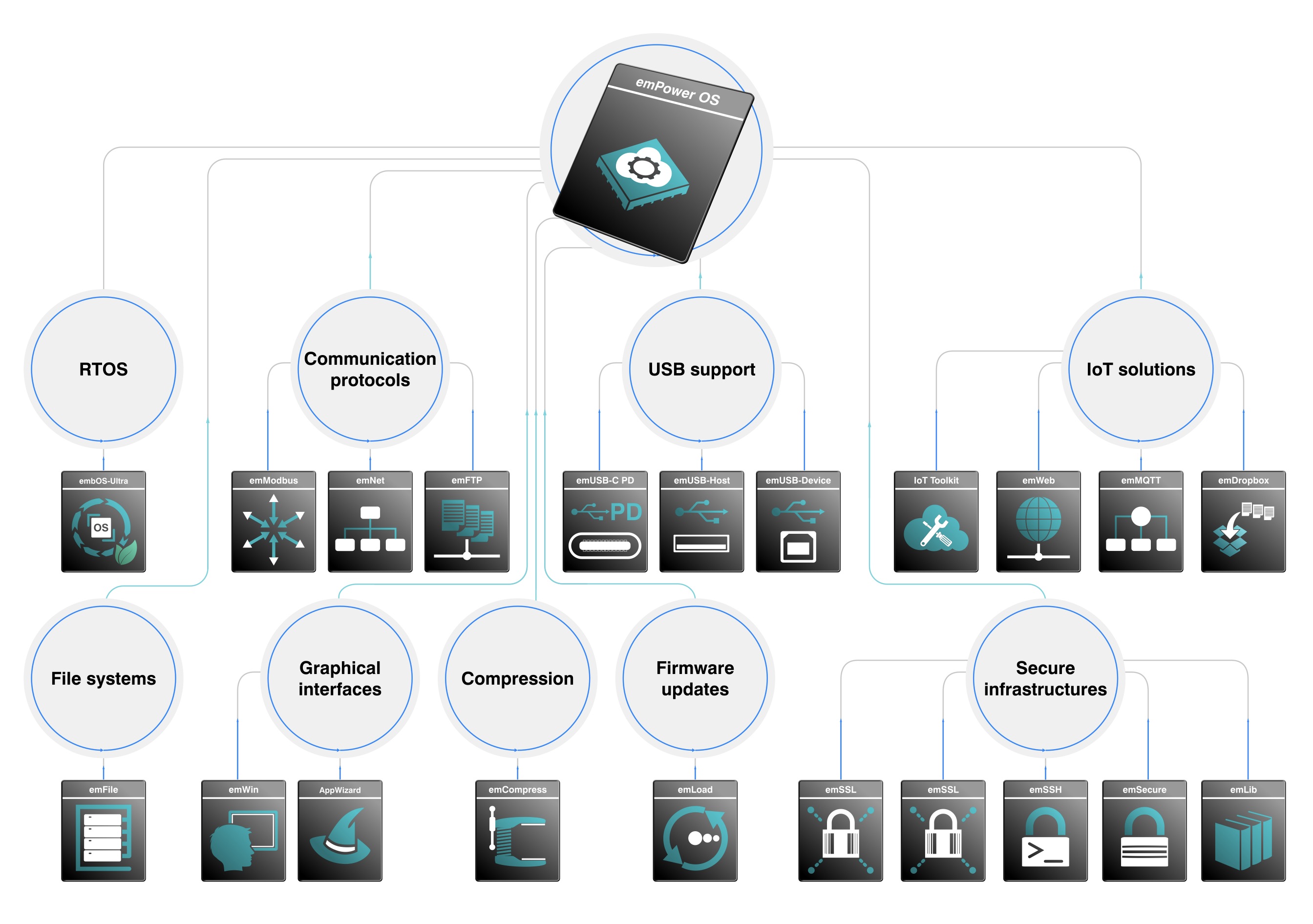
Embedded software development workflow with SEGGER development tools

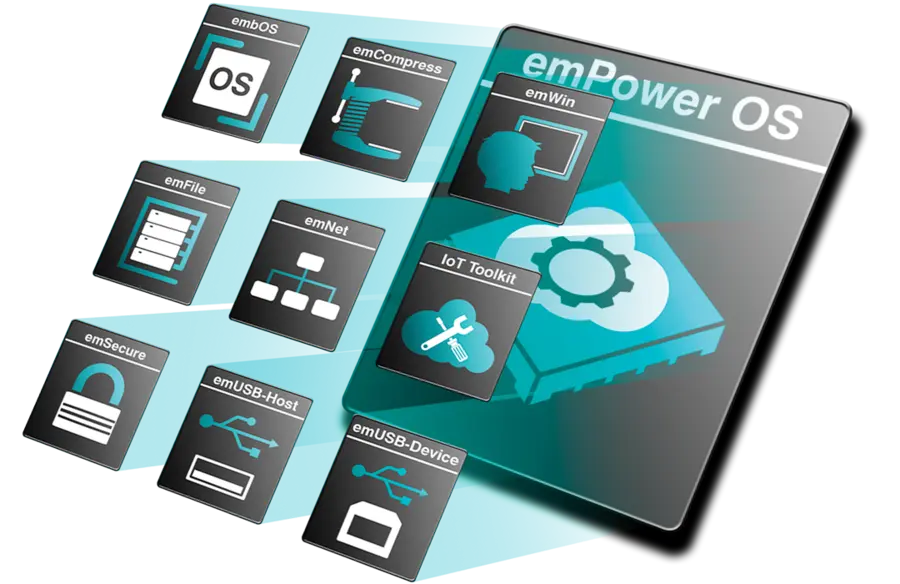
emPower OS

The all-in-one software platform for embedded systems and IoT devices
SEGGER's embedded operating system emPower OS includes multiple software components and offers a robust and versatile operating environment for a wide range of embedded systems. Its modular architecture and ability to optimize performance and support an extensive array of embedded-system development tools make it an excellent choice for developers aiming to create reliable and efficient embedded systems across a variety of industries.

More about emPower OS
SEGGER embOS real-time operating system for embedded applications

Responsive Real-Time Applications

For time-critical applications, such as industrial control systems, medical devices, and automotive systems.

In environments where precise and predictable execution is crucial, a deterministic real-time operating system (RTOS) is required. With its low memory requirements and high efficiency, SEGGER's family of RTOS embOS ensures optimal resource utilization and stable high-performance operation under all conditions.

SEGGER embOS real-time operating system for embedded applications

embOS

embOS is an RTOS family designed to be a foundation for embedded-application development. Now in its fourth decade of continuous use and enhancement, it provides the reliability, versatility, and performance that underpin the firmware of every SEGGER Flasher, J-Link, and J-Trace.

Compatible with all major cores, compilers, and development tools, embOS has been deployed in billions of devices across a broad range of applications.

More about embOS

Reliable Communication Protocols

For networked devices in, e.g., medical technology and the automotive sector, with IP stacks for reliable, encrypted data transmission.

The development and implementation of reliable and secure communication protocols in networked devices is of crucial importance in medical technology and the automotive sector. The use of IP stacks enables reliable and standardized data transmission, while encryption libraries ensure that this data is protected from unauthorized access. In an increasingly connected world, these technologies are essential to ensure the security and integrity of systems and data, especially in areas where human life and safety are at stake.
SEGGER emNet TCP/IP stack for embedded systems

emNet —> Product Details

TCP/IP Stack for Embedded Devices

emNet is a high-performance dual IPv4 / IPv6 IP stack that has been optimized for speed, versatility, and a small memory footprint. It is written for ANSI C and can be used on virtually any CPU.
emModbus —> Product Details

Adding Industry-Standard Protocols

emModbus supports communication via UART (ASCII, RTU) and Ethernet (Modbus / TCP and Modbus/UDP). It is capable of communicating with any Modbus- compliant device.
SEGGER emFTP server for embedded applications

emFTP —> Product Details

Efficient File Transfer for Embedded Devices

emFTP is the ideal software solution for exchanging files via the FTP protocol. Edge devices can easily transfer their collected data to a server or provide them as a service via FTP.

USB Support

For embedded systems in telecommunications, consumer electronics, and more.

Electronics in a variety of industries require reliable software for introducing USB functionality, delivering power, and hosting data. SEGGER's USB support tools are easy to integrate into any embedded environment, are cross-platform, have small memory footprints, and include direct technical support from the product developers.
emUSB-C PD —> Details

USB-C Power-Delivery Management

emUSB-C PD is a complete power delivery protocol implementation for USB-C as defined by USB-IF, and it is specially designed for use in embedded devices.
emUSB-Device —> Details

Boosting Connectivity

emUSB-Device is a high-speed USB-device software specifically designed for embedded systems. Written in ANSI C, it can run on any platform. A wide variety of target drivers are readily available.
emUSB-Host —> Details

IoT Device Enhancement

emUSB-Host implements full USB-host functionality. It enables developers to easily add USB-host functionality to embedded systems.

Secure Infrastructures

For safely authenticating digital assets, protecting communications, and ensuring the integrity of embedded systems or native computer applications.

SEGGER offers a range of security solutions to authenticate digital assets and secure communications across multiple applications. These tools address the need for security in embedded system software, protecting devices from unauthorized access and cloning, while ensuring secure data transmission over networks.
emSSH —> Product Details

Secure Shell for Embedded Applications

emSSH provides the ability to establish a secure connection to any server application in the scope of a product. It can be used in target-independent native computer applications as well as in embedded targets/applications.
emSSL —> Product Details

Transport-Layer Security

emSSL is a software library that enables secure connections across the Internet and offers both client and server capabilities.
emSecure —> Product Details

Device Security and Cloning Prevention

emSecure is a software solution for securely authenticating digital assets. It can be used to secure products against hacking and cloning with no additional cost per unit.
emCrypt —> Product Details

The Cryptographic Library

emCrypt is a state-of-the-art cryptographic algorithm library that is scalable from constrained devices to workstations.
emLib —> Product Details

Data Confidentiality and Integrity

emLib is a collection of algorithms for data confidentiality and integrity that are easily deployed into an embedded system. AES, DES, CRC, and ECC encryption and decryp-tion of data at rest or in transit ensures confidentiality.

User-Friendly Graphical Interfaces

For embedded devices via the emWin graphics library, which can be adapted to different display sizes and resolutions.

With its GUI design tool AppWizard, a powerful embedded system development tool, the emWin graphics library can be used to develop user-friendly graphical interfaces for embedded devices, and it allows for flexible adaptation to different display sizes and resolutions. This enables developers to create intuitive and appealing user interfaces that work optimally on a wide variety of devices. The adaptability of emWin ensures that user interfaces remain consistent and user friendly, regardless of screen size or resolution, which significantly improves the user experience.
emWin —> Product Details

The Embedded Graphics Library

emWin is designed to provide an efficient, processor- and LCD-controller-independent graphical user interface (Graphical User Interface) for any application that operates with a graphical LCD.

AppWizard —> Product Details

Transforming GUI Design for Embedded Systems

SEGGER's award-winning AppWizard enables the creation of highly efficient and high-quality graphical user interfaces on any embedded system in the simplest way — without writing any code.

emFile

The Embedded File System

emFile ensures that data is stored securely and transferred reliably, even under demanding conditions. This significantly improves device functionality and longevity.

More about emFile
Rapid Firmware Updates

For embedded systems assure immediate operational readiness in resource-constrained applications, such as consumer electronics.

Fast boot times are critical for ensuring user convenience and minimizing downtime, particularly in areas where memory and bandwidth are limited. With optimized boot sequences and smaller firmware files, updates can be deployed quickly and reliably, even where connectivity is limited. The result? Improved device performance, an enhanced user experience, and preservation of the integrity and security of the update process.
emLoad

emLoad is SEGGER's embedded bootstrap loader for embedded systems. It facilitates the process of updating firmware. This is a crucial part of the lifecycle management of a product. emLoad offers the flexibility to add new features in the field, fix bugs, and address security vulnerabilities after a system has been deployed. It comes with numerous options for the end system user's convenience.

More about emLoad

Efficient Data Compression

...for optimized storage and communication in embedded systems.

Compression is essential in embedded systems because it reduces the size of data, which has many benefits for storage and transmission. By shrinking data, more information - such as firmware updates, configurations, or interface assets - can be stored within limited memory resources such as flash memory or SD cards, making the system more cost-effective and efficient. In applications with low-bandwidth communication, compressed data allows more information to be sent quickly, reducing the time and power needed for data transfers.

emCompress

emCompress efficiently compresses and decompresses data on even the smallest microcontrollers.

Free from open-source or attribution requirements, it allows seamless integration into both commercial and proprietary products without the need to disclose combined source code. Ideal for embedded devices, apps, and PC software, emCompress provides a versatile compression solution.

More about emCompress
Sophisticated IoT Solutions

For connected devices, such as smart home applications.

In order to function seamlessly in connected environments, IoT devices require reliable communication, robust security, and efficient data management. SEGGER contributes to these essentials with its comprehensive loT solutions, which include the loT Toolkit; emMQTT, for secure and reliable messaging; emWeb, for intuitive device management via web interfaces; and emDropbox, for secure data synchronization. These tools ensure that loT devices are not only connected but also secure, responsive, and scalable — meeting the high demands of modern loT applications.
IoT Toolkit —> Details

The loT Library Collection

loT Toolkit is a high-performance collection of libraries optimized for minimum memory consumpt-ion in RAM and ROM, high speed, and versatility. The libraries work on any device.
emWeb —> Details

The Web Server

The web server emWeb allows users to employ the most widely accepted graphical user interface language: HTML.
emMQTT —> Details

Full Support for IoT Pro-tocols

emMQTT is an MQTT client that uses the socket interface. It can be used with any IP stack that supports the socket interface (such as emNet).
emDropbox —> Details

Dropbox Access

emDropbox allows easy access
to Dropbox accounts, allowing
users to synchronize and
access files across multiple
devices.

© 2026 Carnica Technology. All Rights Reserved. Contact Us · Legal & Privacy
emPower OS

Overview

SEGGER's emPower OS is a complete operating system that provides the ideal environment for any developer creating an embedded system or loT device. It can be adapted to run in resource-constrained, single-chip microcontroller systems without external memory or scaled up for highest performance without unnecessary overhead on application processors (MPUs). This all-in-one easy, cost-effective solution supports any vendor, any chip and any cloud provider making it risk-free to change suppliers and individual hardware platforms.

Meeting all the requirements of a cutting-edge, high-performance operating system, the emPower OS software package includes:
• Real-time operating system (RTOS)
• Standard software libraries/middleware
• Security algorithms and protocols
• Connectivity libraries (USB, Ethernet, WiFi, Modbus)
• User interface & graphic libraries
• File system & compression algorithms

All software components work seamlessly together and are continuously tested on a variety of microcontrollers/ microprocessors from different vendors. They are written in plain C and can be compiled by any standard ANSI/ISO C compiler.
Getting started with emPower OS is easy, and that's only the beginning. It also significantly reduces the time required to deliver a product by using robust, well-tested components that simply work. The software components also serve as the solid foundation in SEGGER hardware products, such as the J-Link debug probe, the J-Trace streaming probe and the Flasher production programmer families.

All-in-one solution

emPower OS is a modular all-in-one solution: All software components come from one vendor and are designed to fit together in any combination. Each module is pre-configured to set up its tasks and other resources using embOS as the underlying RTOS. Furthermore, interface layers are set up to enable interconnection of components or to extend them with additional features, classes and protocols.

All software components that directly or indirectly require additional hardware components use well-defined driver interfaces and configuration layers, which are readily available with emPower OS.

emNet

SEGGER emNet is a high-performance TCP/IP stack for embedded systems, enabling customers to add reliable network connectivity to resource-constrained devices. It supports both IPv4 and IPv6 as well as standard protocols including TCP, UDP, ICMP, DHCP, DNS, multicast, and VLAN.

This makes emNet suitable for connected industrial devices, IoT and edge applications, embedded web interfaces, remote configuration, and communication with cloud or local network services. Optional add-ons extend functionality with protocols and services such as FTP, HTTP, MQTT, CoAP, SNMP, WebSocket, and PTP.

Key advantages include high network performance, deterministic behavior, and a small RAM and ROM footprint. Zero-copy technology reduces unnecessary data transfers and improves throughput. emNet is hardware-independent, supports internal and external Ethernet controllers, and provides a flexible driver layer for adapting the stack to different MAC and PHY hardware.

Integration into an existing development environment is flexible. emNet is written in ANSI C and applications communicate with it through a familiar BSD-style socket API, simplifying the migration of existing network applications. Hardware dependencies are isolated in the network-interface driver, minimizing platform-specific changes.

emNet integrates seamlessly with SEGGER embOS but can also operate with other RTOSes or without an RTOS, including superloop architectures. It can be delivered as source code and incorporated into existing firmware projects, allowing teams to retain their established hardware, compiler, IDE, and application architecture while adding a complete embedded networking solution.

emModbus

SEGGER emModbus is a compact Modbus protocol stack that enables embedded devices to communicate with virtually any Modbus-compliant system. It supports Modbus Master and Slave implementations as well as the standard RTU and ASCII protocols over UART and Modbus/TCP over Ethernet, with additional support for Modbus/UDP. This makes it well suited for industrial automation, energy management, process control, building automation, and applications connecting PLCs, sensors, actuators, drives, meters, or other industrial equipment.

Key advantages are its small memory footprint, portability, and flexibility. emModbus is optimized for resource-constrained microcontrollers, requires no dynamic memory allocation, and allows features to be configured according to application requirements. Written in portable ANSI C, it is hardware-independent and can run on virtually any target. Multiple communication interfaces can be used in the same product and configured at runtime.

Integration into an existing development environment is straightforward. emModbus can be delivered as source code and includes configuration files and sample applications for the supported protocols. Its kernel abstraction layer allows operation with SEGGER embOS, third-party RTOSes, or without an RTOS. For Modbus/TCP, it can work with SEGGER emNet as well as third-party TCP/IP stacks providing standard BSD sockets. This enables development teams to retain their existing MCU, compiler, IDE, RTOS, and networking architecture while adding standardized Modbus communication with minimal platform-specific adaptation.

emFTP

SSEGGER emFTP provides FTP client and server functionality for embedded systems, enabling customers to transfer and manage files over TCP/IP networks. The emFTP Client allows an embedded device to connect to an FTP server to upload or download files, making it suitable for applications such as transferring measurement data and log files, retrieving configuration data, or distributing application resources. The emFTP Server enables external FTP clients to access files stored on the embedded device. Both active and passive FTP modes are supported.

A key advantage of emFTP is its small memory footprint and suitability for resource-constrained embedded devices. It is designed as an optional networking component, allowing developers to add FTP functionality without implementing the protocol themselves. Combined with SEGGER’s emFile file system, applications can provide FTP access to files stored on media such as flash memory or SD cards.

Integration into an existing development environment is straightforward. emFTP can be added as an add-on to SEGGER emNet in the same way as other emNet components. Developers add the required source files and configuration to their existing firmware project and use the supplied sample applications as a starting point. emNet itself is written in ANSI C and is independent of a specific IDE; SEGGER Embedded Studio, other ANSI C toolchains, or makefile-based environments can be used. This makes emFTP well suited for adding standardized file-transfer capabilities to existing embedded applications with minimal impact on the overall software architecture.

emUSB-C PD

SEGGER emUSB-C PD is a compact USB Type-C and Power Delivery software stack that enables embedded systems to detect connected USB-C devices, determine power and data roles, and dynamically negotiate power delivery. Devices can operate as a Source or Sink and identify whether USB Host or Device functionality is required. emUSB-C PD supports dynamic power negotiation up to 20 V / 3 A and role swapping, making it suitable for battery-powered products, industrial equipment, portable devices, and other applications requiring intelligent USB-C power management.

Key advantages include flexibility, efficient power management, and a small embedded footprint. By negotiating the appropriate voltage and current, devices can enable faster charging or optimize their power supply. Role swapping can also help prevent sudden power loss—for example, allowing a battery-powered device to take over as power source when external power disappears. The stack is implemented in efficient ISO/ANSI C and separates the hardware-independent protocol functionality from controller-specific drivers.

Integration into an existing development environment is simplified by this modular architecture. Developers integrate the hardware-independent emUSB-C protocol stack together with a driver for the selected USB-C/PD controller and configure the required Source, Sink, and Power Delivery functionality. The Base module can also be used independently when full Power Delivery communication is not required. This separation minimizes hardware-specific changes and allows emUSB-C PD to be incorporated into existing embedded firmware architectures and ANSI C development workflows.

emUSB-Device

SEGGER emUSB-Device is a high-performance USB device stack that enables customers to add USB connectivity to embedded products. It allows a microcontroller-based system to communicate with PCs or other USB hosts using standard USB classes such as Mass Storage (MSD), CDC/serial communication, HID, MTP, networking, audio, video, MIDI, and DFU, as well as vendor-specific protocols. Multiple interfaces can also be combined to create composite USB devices. emUSB-Device supports USB 1.1, USB 2.0, and USB 3.0, including Full-Speed, High-Speed, and SuperSpeed operation.

Key advantages include high performance, a small memory footprint, portability, and flexibility. The stack is written in efficient ANSI C and uses a modular architecture, allowing developers to include only the components required by their application. Standard USB classes can often use operating-system drivers already available on the host, reducing the need to develop and maintain custom PC drivers. A hardware abstraction layer simplifies support for different USB controllers and MCUs.

Integration into an existing development environment is straightforward. Developers start with their existing target project, add the required emUSB-Device source files, USB class components, hardware driver, and target-specific configuration. Sample applications and configurations for supported evaluation boards provide practical starting points. emUSB-Device can be used with SEGGER embOS, other RTOSes, or without an RTOS in superloop applications. It is not tied to a specific IDE or compiler and can be integrated with any suitable ANSI C toolchain or makefile-based build environment.

emUSB-Host

SEGGER emUSB-Host is a high-performance USB host stack that enables embedded systems to connect to and control USB devices. Customers can add support for peripherals such as USB flash drives, keyboards, mice, barcode scanners, printers, audio devices, serial adapters, smart-card readers, cameras, and Ethernet-over-USB adapters. The stack supports all USB transfer types, multiple devices, external hubs, hot-plugging, and multi-interface devices. Standard and vendor-specific USB classes can be added according to application requirements.

Key advantages include high performance, a small memory footprint, portability, reliability, and modularity. emUSB-Host is written in ANSI C and is CPU-independent. Automatic device detection and enumeration simplify application development, while internal pipe management and error-recovery mechanisms help ensure reliable operation. Its modular architecture allows developers to include only the required USB functionality. Commercial licenses are royalty-free, helping provide predictable costs over the product lifecycle.

Integration into an existing development environment is straightforward. Developers start with a working target project, add the required emUSB-Host source files and RTOS abstraction layer, configure the USB host controller and hardware-specific settings, and initialize the required USB class drivers. Sample configurations and applications are available as starting points. emUSB-Host integrates seamlessly with SEGGER embOS, emFile for mass storage, and emNet for USB networking. Other RTOSes can be supported through an adaptation layer. The software is not tied to SEGGER Embedded Studio; any suitable ANSI C toolchain or makefile-based environment can be used.

emSSH

SEGGER emSSH is a compact Secure Shell (SSHv2) library designed to add secure remote access and encrypted communication to embedded systems. It enables customers to securely log in to devices, execute commands, perform diagnostics, configure systems, and protect communication between a client and an embedded server. With the optional SCP add-on, emSSH can also provide secure file transfers, for example to exchange configuration files, logs, or other application data. SSH communication is not limited to TCP/IP; emSSH can secure virtually any bidirectional channel, including serial or wireless links.

A major benefit is its suitability for resource-constrained embedded devices. Written in portable ANSI C, emSSH is compiler- and target-independent and combines a small memory footprint with high performance. Its modular architecture ensures that unused functionality does not need to be linked into the application. It supports common SSHv2 clients, multiple cryptographic algorithms, forward secrecy, and optional hardware acceleration.

Integration into an existing development environment is straightforward because emSSH is delivered as source code with documentation, configuration files, and sample applications. Developers add the required source files and include directories to their existing firmware project, configure the required features, and initialize the library through its C API. Sample “Start” projects provide practical integration references. emSSH integrates seamlessly with SEGGER embOS/IPand can also work with third-party TCP/IP stacks through standard socket interfaces, allowing it to fit into existing architectures without requiring a specific IDE, compiler, or target platform.

emSSL

SEGGER emSSL is a compact SSL/TLS library that enables customers to add secure, encrypted communication to embedded systems. It provides both client and server functionality and can secure applications such as HTTPS web services, REST APIs, FTP transfers, firmware updates, provisioning, and other network communication. Although typically used over TCP/IP, emSSL is transport-independent and can also secure other bidirectional communication channels, such as serial or wireless links.

Key advantages include high performance, a small memory footprint, portability, and flexible configuration. Written in ANSI C, emSSL can run on virtually any CPU and is designed for resource-constrained microcontrollers. Its modular architecture allows developers to include only the required functionality and cipher suites, reducing RAM and ROM requirements. A plug-in cryptography interface also enables the use of hardware cryptographic accelerators to improve performance.

Integration into an existing development environment is straightforward. emSSL is available as source code and provides a simple C API, documentation, configuration options, and sample applications. It integrates seamlessly with SEGGER’s networking stack but can also operate with other IP stacks that provide standard socket functionality or with other bidirectional transports. SEGGER provides BSP “Start” projects as integration references, while the same principles can be applied to different IDEs, compilers, and target platforms. This allows teams to add TLS security while retaining their existing hardware and software architecture.

emSecure

SEGGER emSecure is a digital signature solution designed to protect embedded products, firmware, and sensitive data against unauthorized modification and cloning. Using asymmetric cryptography, customers can digitally sign firmware, software updates, licenses, serial numbers, configuration data, or device-specific information and verify their authenticity before use. A common application is secure boot and firmware updates, where the embedded device verifies a firmware signature and executes only authorized code. emSecure can also bind firmware to unique hardware information, helping prevent copied firmware from operating on cloned devices.

Key advantages include strong authentication, a small memory footprint, high performance, and hardware independence. emSecure is optimized specifically for embedded systems and does not require an additional security device or external memory. RSA and ECDSA variants are available, and the package includes ready-to-use tools for key generation, signing, verification, and conversion of keys and signatures into C-compatible formats. It is also royalty-free, helping provide predictable costs for high-volume products.

Integration into an existing development environment is straightforward. emSecure is supplied as ANSI C source code and provides a compact API that can be incorporated into existing firmware, bootloaders, or production software. Public keys and signatures can be converted directly into C source code or loaded from files. Signing can be performed with the supplied PC tools or integrated directly into an existing production process. Because emSecure is platform- and controller-independent, teams can retain their existing MCU, compiler, IDE, and software architecture while adding digital-signature-based product protection.

emCrypt

SEGGER emCrypt is a comprehensive cryptographic library that enables customers to add encryption, authentication, data integrity, key management, and digital signatures to embedded applications. It provides the cryptographic building blocks required to protect data in transit and at rest or to implement custom security protocols. Supported capabilities include AES and other ciphers, SHA hash families, MACs, RSA and elliptic-curve cryptography, digital signatures, key agreement and derivation, and secure random-number generation. emCrypt also forms the cryptographic foundation of SEGGER products such as emSSL, emSSH, and emSecure.

Key advantages include high performance, a small memory footprint, portability, and extensive configurability. Designed specifically for embedded systems, emCrypt can be optimized for either execution speed or code size. Its modular architecture ensures that only required components are linked into the application. Hardware cryptographic accelerators can also be integrated to increase performance and reduce CPU load.

Integration into an existing development environment is straightforward. emCrypt is provided as ANSI C source code and is compiler- and target-independent, allowing it to be incorporated into existing MCU firmware as well as PC applications. Developers add the required source files, configure algorithms and features at compile time and runtime, provide a suitable random-number source, and initialize the library through its C API. Sample applications and configuration examples provide practical starting points. This allows teams to retain their existing MCU, IDE, compiler, RTOS, and application architecture while adding professional cryptographic functionality.

emLib

SEGGER emLib is a collection of compact software modules that enables customers to add cryptographic and data-integrity functionality to embedded applications without developing these algorithms from scratch. Available modules include AES and DES encryption, CRC checksum calculation, and ECC (Error Correction Code). These functions can be used to protect sensitive data, verify data integrity, detect transmission or storage errors, and correct certain bit errors. The same modules can also be used in PC applications, simplifying the development of complementary host-side software and test tools.

Key advantages include high performance, minimal memory requirements, portability, and ease of use. emLib is optimized for resource-constrained embedded systems and provides a simple, consistent API across its modules. Its ANSI C implementation makes it highly portable across processor architectures, from 8-bit to 64-bit systems. The modular design allows developers to integrate only the functionality required by their application.

Integration into an existing development environment is straightforward. Individual emLib modules can be added to an existing firmware project as needed and are available as source code. Because the implementation is ANSI C and hardware-independent, developers can continue using their existing MCU, compiler, IDE, RTOS, and application architecture. The same APIs can be used on both embedded targets and PCs, while included sample and validation applications provide practical references for integration and testing. This makes emLib a flexible way to add optimized, proven algorithms without significantly changing an established development workflow.

emWin

Key features
em Win simplifies the process of creating visually appealing and user-friendly interfaces, reducing development time and effort. It provides an easy-to-use and powerful API as well as functions for tasks such as drawing shapes, rendering images, handling touch inputs, managing display buffers, and interfacing with display hardware.
emWin is a crucial element for embedded projects that require GUls, data visualization, or any form of visual feedback.

Great portability and versatility
Users can integrate emWin into new hardware platforms and a variety of microcontroller
architectures. It runs on any platform, from low-end microcontrollers to high-end processors with varying capabilities. It also supports any microcontroller, display, or display controller, and it enables Ul functionality on headless devices through VNC.

High-quality drawing operations
emWin core functionalities are designed for precise rendering of all graphical elements, including lines, shapes, gradients, and bitmaps. Included here are the rendering functions for the window manager, widget library, and font support. Developers can apply anti-aliasing to all rendering functions to ensure that any element (including fonts) is displayed with smooth edges. Furthermore, this also applies to alpha blending operations.

Low memory footprint
Optimized for performance and memory use, emWin is tailored to the constraints and requirements of embedded applications. With efficient rendering algorithms and memory-management strategies, it minimizes resource consumption while also maintaining responsive Ul performance.

AppWizard

Create embedded GUI applications quickly & easily

The SEGGER App Wizard is a powerful tool for creating complete, ready-to-run GUl applications using the em Win graphics library.

Thanks to its intuitive setup, users have the power to create stunning applications,no coding skills needed. With the AppWizard and SEGGER's emWin graphics library, creating even complex graphical applications is easier than ever.

Integrated resource management means all resources (fonts & images) are automatically converted. Users can preview the application in a simulated environment with a single click by running Play Mode. AppWizard Projects can be easily exported to a simulation or target project.

emFile

Overview

SEGGER emFile is a high-performance, fail-safe file system designed to provide reliable data storage and file management in embedded systems. It enables applications to create, read, write, organize, and manage files on storage media including NAND and NOR flash, SD/SDHC/SDXC cards, eMMC, RAM, and USB mass-storage devices. emFile supports standard FAT12/16/32, SEGGER’s Embedded File System (EFS), and optional exFAT and BigFATfunctionality for large files and storage volumes.

Key advantages include high performance, low RAM and ROM requirements, data integrity, and broad storage-media support. Fail-safe mechanisms use atomic operations to protect file-system consistency during unexpected power loss. Optional journaling, RAID 1/5, encryption, wear leveling, and ECC provide additional reliability and security. Its modular architecture allows developers to select the required file system, storage drivers, and optional components, making emFile suitable for both small embedded devices and applications with large storage requirements.

Integration into an existing development environment is straightforward. emFile is written in portable ANSI C and can run on virtually any CPU. Its API follows familiar ANSI C stdio-style file operations, simplifying migration from existing file-handling code. Developers add the required emFile components to their project and connect the storage layer to the target hardware through simple low-level read/write functions or SEGGER-provided device drivers. emFile works with different operating systems and toolchains; SEGGER Embedded Studio is used in the documentation, but other ANSI C toolchains and makefile-based environments are supported as well.

emFile

Overview

SEGGER emFile is a high-performance, fail-safe file system designed to provide reliable data storage and file management in embedded systems. It enables applications to create, read, write, organize, and manage files on storage media including NAND and NOR flash, SD/SDHC/SDXC cards, eMMC, RAM, and USB mass-storage devices. emFile supports standard FAT12/16/32, SEGGER’s Embedded File System (EFS), and optional exFAT and BigFATfunctionality for large files and storage volumes.

Key advantages include high performance, low RAM and ROM requirements, data integrity, and broad storage-media support. Fail-safe mechanisms use atomic operations to protect file-system consistency during unexpected power loss. Optional journaling, RAID 1/5, encryption, wear leveling, and ECC provide additional reliability and security. Its modular architecture allows developers to select the required file system, storage drivers, and optional components, making emFile suitable for both small embedded devices and applications with large storage requirements.

Integration into an existing development environment is straightforward. emFile is written in portable ANSI C and can run on virtually any CPU. Its API follows familiar ANSI C stdio-style file operations, simplifying migration from existing file-handling code. Developers add the required emFile components to their project and connect the storage layer to the target hardware through simple low-level read/write functions or SEGGER-provided device drivers. emFile works with different operating systems and toolchains; SEGGER Embedded Studio is used in the documentation, but other ANSI C toolchains and makefile-based environments are supported as well.

emLoad

Overview

SEGGER emLoad is an embedded bootstrap loader that enables customers to update firmware in deployed embedded systems. It allows new features, bug fixes, and security updates to be installed without replacing or physically reprogramming the device. Firmware can be transferred through interfaces such as UART, USB Device, USB Host mass storage, SD cards, or NFC, making emLoad suitable for consumer electronics, industrial equipment, and connected devices. In-place updates can be performed without storing the complete firmware image in persistent memory.

Key advantages include a small memory footprint, fast and reliable firmware transfer, flexible configuration, and broad hardware portability. CRC checks can verify firmware integrity, while optional ECDSA authentication and AES-256 encryption provide additional protection for update packages. emLoad is written in ANSI C and can run on virtually any target architecture.
Integration into an existing development environment is straightforward. emLoad is delivered in source-code packages and includes a reference implementation. Developers integrate the bootstrap loader into the existing firmware project and adapt the hardware-specific components for the target MCU, flash memory, and selected update interface. SEGGER also provides Windows tools for preparing and transferring firmware images. This approach allows teams to retain their established compiler, toolchain, target hardware, and application architecture.

Note: emLoad is now a legacy product. For new designs, SEGGER recommends emBoot-Secure as its modern, security-focused successor.

emCompress

Overview

SEGGER emCompress is a family of highly efficient compression libraries designed to reduce data size in embedded systems. Customers can use it to compress firmware updates, configuration data, FPGA/CPLD bitstreams, user-interface assets, data logs, or communication data. Depending on the selected edition—emCompress-Pro, emCompress-ToGo, emCompress-Embed, or emCompress-LZMA—compression and/or decompression can be performed on the embedded target or host system. This can significantly reduce storage requirements and the amount of data transferred over bandwidth-limited connections.

Key advantages include a small memory footprint, high performance, flexibility, and reduced communication traffic. Smaller firmware and data packages can reduce flash requirements and hardware costs, while compressed transfers can accelerate firmware updates and lower network traffic and power consumption. emCompress supports several compression algorithms and includes solutions optimized even for highly resource-constrained microcontrollers. The implementation is portable ANSI C and does not impose open-source attribution requirements on commercial products.

Integration into an existing development environment is straightforward. emCompress is delivered in source-code packages and is independent of the target processor and compiler. Developers add the required compressor or decompressor modules to their existing firmware or host application and use the provided APIs and utilities. For example, emCompress-Embed compresses data on the development host and embeds it into the firmware, where a compact decompressor expands it on demand. emCompress-Pro provides a familiar zlib-like API for files and data streams. This allows teams to retain their existing MCU, IDE, compiler, RTOS, and application architecture while adding efficient compression.

IoT Toolkit

SEGGER IoT Toolkit is a collection of embedded software libraries that enables customers to connect embedded devices to modern web and cloud services. It combines an HTTP client with efficient JSON and SAX parsers, allowing applications to retrieve web content, exchange structured data, and interact with REST APIs. Typical use cases include sending sensor data to cloud services, retrieving configuration information, accessing web-based services, or integrating embedded products with existing IoT infrastructures.

Key advantages include low memory consumption, high performance, portability, and modularity. The toolkit is optimized for resource-constrained microcontrollers and only required modules need to be linked into the application. Its simple API reduces the effort involved in implementing HTTP and JSON functionality from scratch. The software is written in ANSI C, is hardware-independent, and is supplied royalty-free under SEGGER’s commercial licensing models. Secure HTTPS communication can be added using SEGGER emSSL.

Integration into an existing development environment is straightforward because the IoT Toolkit is delivered as source code with configuration files, documentation, and sample applications. Developers add the required HTTP and/or JSON modules to their existing firmware project and configure them according to the application. The hardware-independent architecture allows the toolkit to run on virtually any CPU. It integrates particularly well with SEGGER’s networking and security components, such as emNet/embOS-IP and emSSL, while the supplied examples demonstrate functions including HTTP GET requests, secure connections, authentication, and JSON processing. This allows teams to add cloud and REST connectivity while retaining their existing application architecture and development workflow.

emWeb

SEGGER emWeb is a compact embedded web server that enables customers to provide browser-based user interfaces for embedded devices. It allows users to configure, monitor, and control a device from PCs, tablets, or smartphones without installing dedicated client software. emWeb supports static and dynamic web pages as well as technologies such as HTML, JavaScript, AJAX, Server-Sent Events (SSE), REST, forms, and CGI-based dynamic content. Optional WebSocket support enables interactive, bidirectional communication.

Key advantages include a small memory footprint, high performance, platform independence, and flexible UI design. Multiple simultaneous connections and authentication are supported, while efficient buffer handling minimizes RAM requirements. Web content can be stored using the included read-only file system or another file system. Because the interface runs in a standard browser, one web-based UI can serve different host operating systems and device types, reducing development and maintenance effort.

Integration into an existing development environment is flexible. emWeb is optimized for SEGGER emNet, but can also operate with other RFC-compliant TCP/IP stacks providing socket functionality. The web server runs as a task/thread in a multitasking environment. SEGGER supplies ready-to-use examples for embedded targets and Windows, including IPv4/IPv6 and secure SSL configurations, which can be adapted to existing projects. Web pages can also be converted into C data for direct integration into firmware. With SEGGER’s USB technologies, emWeb can additionally provide browser-based interfaces to USB-connected products.

emMQTT

SEGGER emMQTT is a lightweight MQTT client library that enables embedded devices to exchange data efficiently with IoT platforms, cloud services, and other connected systems using the publish/subscribe model. It supports MQTT versions 3.1.1 and 5.0 and can publish sensor data, device status, events, or telemetry and subscribe to commands and configuration updates. Features such as Quality of Service (QoS), retained messages, and Last Will messages support reliable communication and device monitoring.

Key advantages include a very small memory footprint, low communication overhead, scalability, and broad compatibility. emMQTT is optimized for resource-constrained microcontrollers and works with standards-compliant MQTT brokers, whether deployed locally or in the cloud. Its asynchronous publish/subscribe architecture decouples devices from backend applications, making it well suited for large IoT and M2M systems. Secure MQTT over TLS can be implemented in combination with SEGGER emSSL.

Integration into an existing development environment is straightforward. emMQTT uses a socket-based interface and is independent of the underlying TCP/IP stack, so it can operate with SEGGER emNet or any third-party IP stack providing standard sockets. The software can be delivered as source code and incorporated into existing firmware projects. SEGGER also provides a ready-to-use PC client application for testing broker connections, subscriptions, and publishing before transferring the implementation to the embedded target. This allows teams to retain their existing MCU, network stack, toolchain, and software architecture while adding standardized MQTT connectivity.nd allows emUSB-C PD to be incorporated into existing embedded firmware architectures and ANSI C development workflows.

emDropbox

SEGGER emDropbox is a compact software library that enables embedded applications to securely access and exchange files through Dropbox. Devices can upload and download files, list directory contents, rename or delete files, and use Dropbox as an intermediary between devices in the field and a central host system. Typical applications include distributing firmware updates and configuration files to remote devices or collecting log files and measurement data from them. Because files are exchanged through cloud storage, the embedded device and central host do not need to be online simultaneously.

Key advantages include simple deployment, secure communication, a small memory footprint, and hardware independence. emDropbox uses the official Dropbox API v2 and TLS-encrypted communication. Its modular architecture ensures that only required functionality is linked into the application. Written in ANSI C, it is designed to run efficiently even on resource-constrained single-chip microcontrollers.

Integration into an existing development environment is straightforward. emDropbox is available as source code and includes configuration files, documentation, and sample applications for embedded targets and Windows. Developers add the required source files and include paths to their existing project and can use SEGGER’s sample “Start” projects as integration references. emDropbox builds on SEGGER’s IoT Toolkit and emSSL and can use emNet or another TCP/IP stack that provides standard socket functionality. This allows teams to retain their existing MCU, compiler, IDE, and network architecture while adding secure Dropbox-based file exchange.