
🟠 What is Percepio Detect?
Recognize and Capture Runtime Problems as They Occur
Percepio Detect continuously monitors RTOS-based embedded software for crashes, timing anomalies, multithreading issues and other stability risks. Running directly on the target system, it captures diagnostic information when problems occur — helping development and test teams investigate sporadic issues without first having to reproduce them in the development laboratory.
When Bugs Don't Happen on Demand
Some embedded software problems are easy to reproduce. Others appear only after hours or days of operation, under particular timing conditions or through an unusual interaction between tasks, interrupts and system resources.
These intermittent problems can consume considerable engineering time because developers often have little information about what actually happened when the problem occurred.
Detect takes a different approach.
Instead of waiting for a developer to reproduce the problem in the laboratory, Detect monitors the running system and captures information when relevant problems or warning conditions occur.
This makes it particularly useful for finding sporadic problems that may otherwise disappear before developers have an opportunity to investigate them.
Monitor What Matters Over Time
Detect monitors software timing and resource usage directly on the target system.
Developers can define warning thresholds for relevant runtime metrics, allowing Detect to identify and capture diagnostic information when unusual conditions occur.
Because this monitoring takes place on the device, it can remain active over long observation periods without continuously streaming large amounts of trace data to a host computer.
This makes Detect particularly valuable during integration testing, automated testing, endurance testing and field testing — situations where embedded systems may operate unattended for hours, days or even weeks.
Alerts can also be retained across crashes and restarts, preserving valuable information about intermittent problems.
The objective is not to collect as much data as possible.
The objective is to capture the right information when something unusual happens.
Capture the Evidence When Something Goes Wrong
When Detect identifies a relevant problem, it can preserve detailed diagnostic information for subsequent investigation.
Depending on the event, this can include system traces for analysis with Tracealyzer as well as core dumps with call-stack information for fault conditions.
Developers therefore do not have to continuously record and transfer everything that happens inside the system.
This is particularly important for failures that are difficult to reproduce: the evidence is captured when the problem actually occurs, rather than after the development team has spent hours trying to recreate it.
Detect and Tracealyzer Work Together
Detect and Tracealyzer have complementary roles within the development process.
Tracealyzer helps developers investigate and understand runtime behavior in depth.
Detect helps recognize when that behavior indicates a problem or stability risk — and captures the information needed to investigate it.
When Detect identifies a relevant event, trace information can be made available for detailed analysis with Tracealyzer. Developers can then examine what happened around the event and investigate its possible root causes.
This combination avoids the need to continuously stream large amounts of trace data to a host computer while still providing detailed runtime information when it is actually needed.
In simple terms:
Detect finds the moment worth investigating.
Tracealyzer helps you understand it.
See Detect In Action
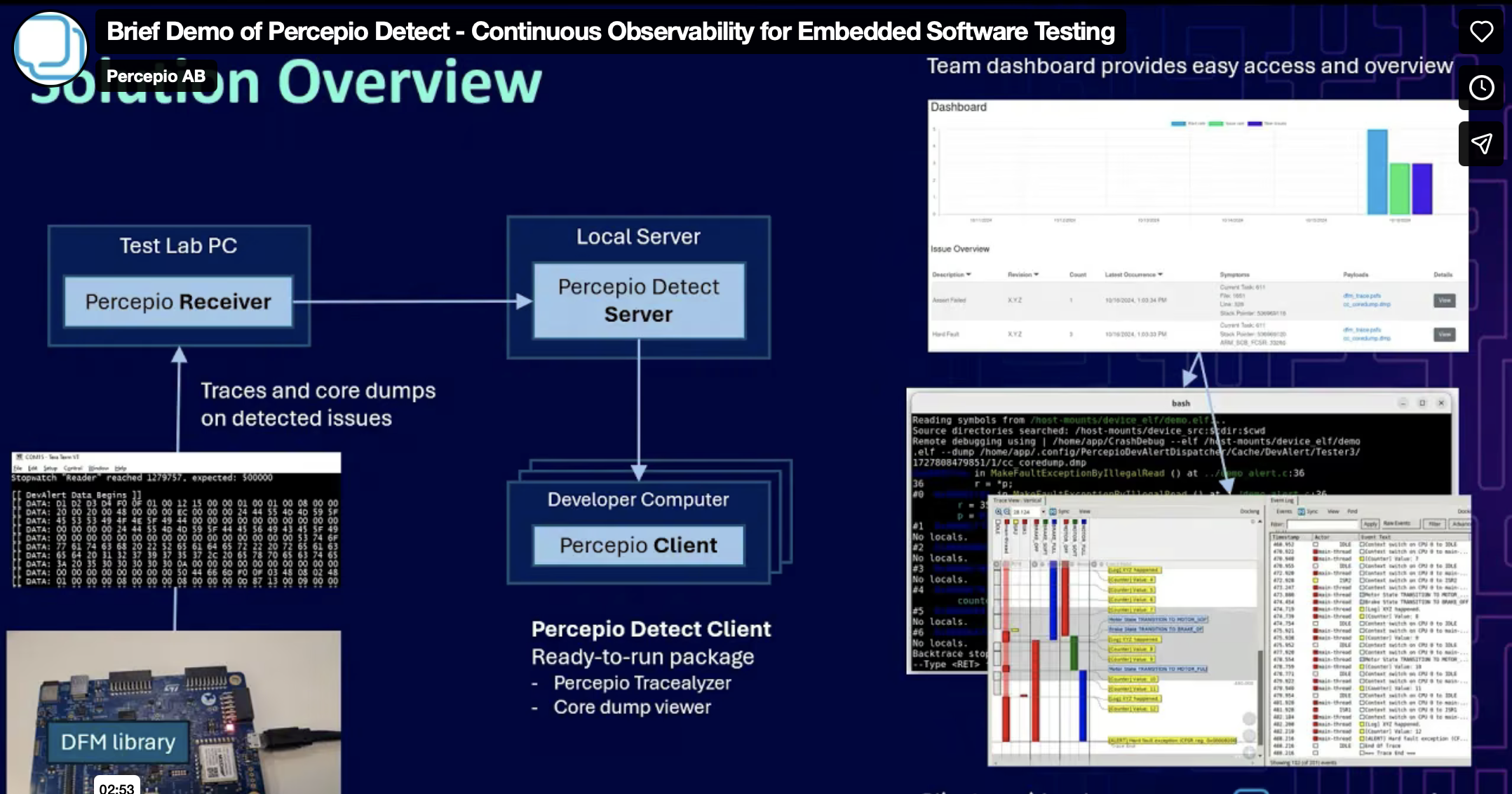
From Continuous Monitoring to Continuous Observability
Detect is a core component of Percepio's broader Continuous Observability approach.
While Tracealyzer provides deep visual runtime analysis during development, integration and testing, Detect adds the ability to monitor software continuously over extended periods and capture diagnostic information when relevant events occur.
DevAlert extends this concept further by bringing diagnostic information from deployed devices back to the development organization.
Together, these technologies create an overarching feedback loop:
Observe → Detect → Understand → Improve → Repeat
Instead of treating debugging as an activity that begins only after a failure has been reported, Continuous Observability allows information from the running system to become an ongoing input to software development and improvement.
Detect in Your Development and Test Environment
Detect is designed to operate directly on the embedded target and can remain active during extended integration, system and field testing.
It can also be incorporated into automated and continuous testing workflows. Runtime problems, performance-related warnings and other stability risks can therefore become part of the information collected during regular CI/CT processes.
Because Detect monitors the system on the device, long observation periods are possible without requiring continuous high-bandwidth trace streaming.
This extends observability beyond interactive debugging sessions and allows software behavior to be monitored while applications are exercised repeatedly, automatically and under more realistic operating conditions.
Detect – RECOGNIZE & CAPTURE
Within Continuous Observability, the role of Detect can be summarized as:
RECOGNIZE & CAPTURE
Detect helps development teams recognize stability risks and capture diagnostic evidence when relevant problems occur.
Tracealyzer - UNDERSTAND
Gain deep visual insight into runtime behavior and investigate root causes.
DevAlert - FEEDBACK
Feedback diagnostic information from testing and deployed devices back to development.
Together, they form Percepio's approach to Continuous Observability.
Continue Exploring
Features, supported platforms and detailed product information:
Services & Support
Evaluation Software
NEWSLETTER & Training
Update: October 3rd, 2026
© 2026 Carnica Technology. All Rights Reserved. Contact Us · Legal & Privacy