
🟠 Percepio Detect
Systematic Runtime Monitoring for RTOS-Based Embedded Software
Percepio Detect provides systematic runtime monitoring for RTOS-based embedded software
during testing and QA. As the RECOGNIZE & CAPTURE component of Continuous Observability, it
helps identify stability risks and preserve diagnostic evidence when relevant problems occur.
Key Highlights
- Capture crash dumps and system traces for subsequent analysis
- Debug faster with automatic crash dumps and system traces
- Monitor your system over unlimited time
- Detect timing and multithreading issues
- Integrates into CI/CT workflows
- Private on-premise server for full control over sensitive data
Catch Elusive Issues Early
Collaborate Across Development and Testing
Percepio Detect is designed as a team solution. A shared server and web-based dashboard allow development and testing teams to collect, review and share information about detected stability risks and runtime anomalies.
Detect can also be integrated into continuous integration and continuous testing workflows, allowing runtime monitoring and detected alerts to become part of regular automated testing.
Integrated Tracealyzer support provides system traces for detected issues without requiring continuous high-bandwidth trace streaming to the host. Detect runs independently on the target and can monitor system stability over extended periods, including field testing.
For fault conditions such as hard fault exceptions, Detect can also provide core dumps with call-stack information for subsequent investigation.
Together, Detect and Tracealyzer provide complementary levels of runtime insight:
Detect recognizes and captures the event.
Tracealyzer helps developers understand what happened.
Monitor System Behavior Over Extended Periods
Detect enables systematic monitoring of software timing and resource usage over extended periods without requiring continuous high-bandwidth trace streaming.
Performance metrics are monitored directly on the target and can trigger alerts when defined warning levels are exceeded. This allows testing to continue for hours, days or even weeks while Detect watches for stability risks and unusual runtime behavior.
Alerts can be stored on the device and retained across crashes and restarts, helping preserve valuable diagnostic information about intermittent problems.
Detect monitoring can also be incorporated into regular integration and continuous testing, allowing multithreading risks, timing anomalies and other stability issues to be identified earlier in the development process.
Continuous Observability by Percepio
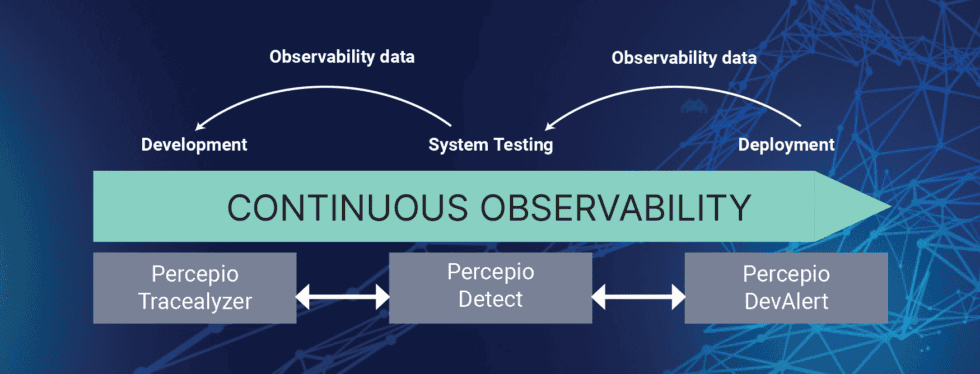
Percepio Detect is the RECOGNIZE & CAPTURE component of Percepio's Continuous Observability approach.
During integration, automated testing and field testing, Detect monitors embedded software over extended periods and preserves diagnostic evidence when relevant problems or stability risks occur.
Combined with Tracealyzer for deep runtime analysis and DevAlert for diagnostic feedback from remote and deployed devices, Detect contributes to an overarching engineering feedback loop:
Observe → Detect → Understand → Improve → Repeat
Services & Support
Evaluation Software
Update: September 25th, 2026
© 2026 Carnica Technology. All Rights Reserved. Contact Us · Legal & Privacy